Alumni Spotlight: Thomas Oechel
4/22/2024 6:30:00 PM | Men's Tennis
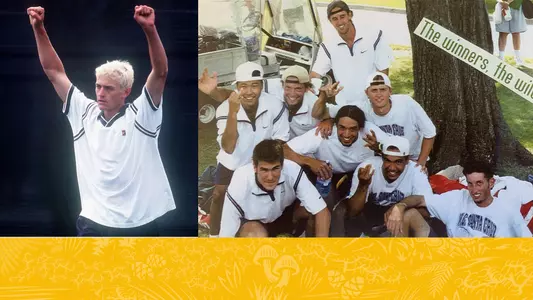
Thomas Oechel graduated from UCSC in 2000 with a degree in Psychology, but what he learned from his time at the school didn't come just from the classroom, it also came from his time with the tennis team. Oechel ended his college career as not only one of the most decorated UCSC athletes ever but also one of the most accomplished NCAA Division III athletes ever.
An All-American all four years, Oechel was the 1997 national Rookie of the Year, the 1999 NCAA Singles champion, and won a then-unprecedented three consecutive national titles in doubles. He gave a lot of credit for his success and the team's to his head coach Bob Hansen .

"There was something special about that old man. As far as that program goes, the heart and soul was with Bob Hansen. I think if you met anybody or talked to anybody, they know that, but Bob would say the opposite. He would say that we players were the reason for the success. But, ultimately we wouldn't have been here if it wasn't for him. He took pride in taking players who hadn't gotten to their potential yet."
This is reflected in Coach Hansen's ability to get recruits to UC Santa Cruz even without recruiting in the classic sense. In the case of Oechel, his father knew the coach.
"Bob was the tennis program director at an old club way back in the day. They knew each other from that and my dad suggested I go and take a visit to Santa Cruz. It was funny because Bob doesn't recruit either. He didn't start recruiting until maybe the class after me, I think. In my class, Justin Balas and Josh Goodley were transfers. I was kind of the only "true" freshman that played on the team. In the next year, Bob saw the writing on the wall and was like 'I gotta recruit guys to get back into this a little bit.' "
The next year, Hansen brought in Danny Kim, Peter Gladkin, and Derek Fitzpatrick, who helped UC Santa Cruz win the national title in 1998 and served as the backbone of the Slugs tennis dynasty in the early 2000s.

After the fact, it is easy for Oechel to look back and smile at his time with the team but it wasn't always easy. His doubles partnership with Brian Cummings, despite being one of the most successful in college history, was strained at the start to say the least.
"Brian and I were fighting in the beginning because we had different philosophies for how to play doubles at that point. Both were right and good for our game, but we couldn't get our games to match. We were good enough to win matches but it wasn't pretty most of the time. It took us three years to finally start understanding each other. It was so bad during a match (at the ITA Fall Nationals), Bob showed up halfway through the first set because he didn't want to be seen with us."
Even with being partners in doubles, they ended up facing each other in three finals. The last meeting was extremely special: Oechel defeated Cummings in the finals of the 1999 NCAA Singles Championship. With the win, Oechel became the first men's tennis player and second Banana Slug in any sport to win an individual national title. It was also the only time Oechel ever beat his teammate.
"I never beat Cummings once in practice or in a challenge match. I played him three in finals: in the finals of Ojai one year, the finals of the Rolex tournament (now known as the Fall ITA), and the NCAA final. When we met and I won in the national championship, I think that year we were ranked in the top 25 of all of the colleges- Division I, II, and III. We were beating teams in the top 20. We were nasty."

After his Banana Slug career ended, Oechel went on to play tennis professionally in Europe before finding a career at his own agency specializing in representing makers of architectural and landscape furnishings. Oechel also wanted to highlight his teammates success on and off the court, and gave credit to their in part due to coach Hansen and the concepts he instilled in all of them.
"Most of the tennis team, they're pretty damn successful. We are all very tight to this day. All these guys have gone on to have the same concepts for how to tackle life as Bob instilled in us. I try to instill the same thing in my kids: It's not about winning the game today, it's about getting better and using competition as a way to showcase your abilities. Bob didn't care if we won or lost, he cared if we didn't prepare properly and lost because of it. If we got beat, we all looked at that as the best thing ever because now we had a lot of stuff to work on and a lot of ideas.
"Ultimately, what it all comes down to is: if you love the sport enough, you love competition because that's a day where you get to showcase all the hard work that you've been putting in and you can present it to people."
Kristi Truong contributed to this story.