UC Santa Cruz Athletics

NCAA Championships

3/14/2024 12:00:00 PM | Women's Swim and Dive, Men's Swim and Dive
Capping off a record-breaking season, the quartet of Pia Davila, Maddy Gruender, Tereza Shea, and Coralie Norenberg are heading to North Carolina for the NCAA Championships to compete in the 400 freestyle relay.
Finding out about qualifying was no easy matter. Head Coach Matthew Crawford explains, "There was a misprint issue where the qualified relays were not on the sheet. Our 400 was not on the sheet, so I assumed that meant we weren't 20th, and we weren't in."
Part of Crawford's worry came from the standard practice of other schools submitting aggregate times, which is when teams submit times from their four best swimmers who didn't necessarily swim together in a relay.
It was a relief to the team when they found out that they did qualify. Davila explains, "I remember watching Claremont-McKenna because they were the last conference. They were super close to us, and then they just barely missed our time so that was really exciting just to be able to breathe after that."
This is the first time in Coach Crawford's tenure that this many UC Santa Cruz swimmers have qualified for nationals. Crawford strategized and used his team's depth at last month's PCSC Championships. After Davila's strong performance in the 100 free race early in the competition, the decision was made to substitute Davila into the 400 free relay. The decision paid off as the quartet swam a school-record 3:28.16, which was better than the time needed to qualify for the NCAA Championships.
With the end of the quarter coming, these swimmers will not only have to worry about difficult competition but also their classes' finals. Coach Crawford explains, "I don't worry about them phoning in their academics. All four of them are very good at that - the majority of the team is. It's something we're proud of: it's a team value that we excel in the classroom."
This fortitude in the classroom translates over to their mental strength during competition. Even though the race isn't until Saturday March 23rd, preparation is underway not only in the pool but out. Gruender explains that "Swimming is a sport with very little forgiveness. The clock never lies. You have to be able to let things go and move on. Our meets are four days long. If you have one bad race, you can't let that stop you. You have three more days of racing. You can't let one little clock get between you and your next race or you are never gonna be able to bounce back from that."
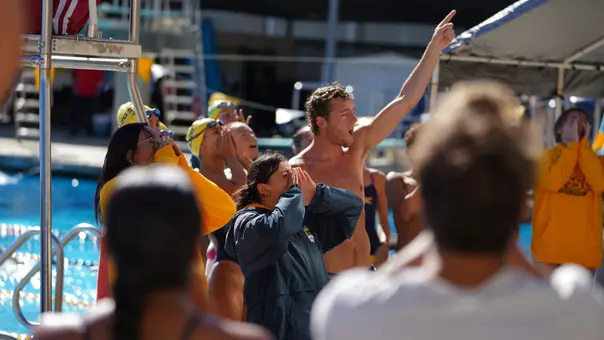
As the anchor of the relay, Shea has all the energy and work placed on her shoulders. "It's definitely very nerve-wracking, everyone's yelling at you, cheering you behind the blocks," Shea said "but at least for me, I feel in the 30 seconds leading up to when you're gonna jump off, everything kind of quiets down and I'm just super focused. I think the adrenaline actually helps me, it motivates me. I just use that to calm down and dial in and complete the race."
Norenberg says, "If you think 'Oh I could have gone harder while swimming', it feels really bad afterward. Telling yourself what you think you can do in the pool before you race is a big part of what I do."