1995- 'En garde!' Tasha Martin Foils competition at NCAA Fencing Championships
12/14/2020 12:00:00 AM | General
Tasha Poissant, née Martin, always made her point in college.
The Portland, Oregon native was a two-time All-American in fencing for the Banana Slugs, being fierce in Foil when the sport had NCAA status on campus.
"Tasha was and continues to be a real special gem of a fencer," said her college coach Peter Burchard, a UCSC alum who is now the president of USA Fencing. "She came in and tore it up. Killed Stanford everytime in our region and was pretty much invincible. Plus, a great person on campus."
Working fulltime for the Oregon Health Authority today, Poissant's love of the sport continues today as she's Chair of USA Fencing's Referee Commission and just began her term August 1. She became a referee while trying to think of cheaper ways to attend competitions after college. She was recruited since there were not many female refs, so she was recruited to referee bouts at tournaments when she wasn't competing, getting partially paid to be there.
After taking a break when her son was born, she then started refereeing again full-time around 2012. She then moved into an evaluator role, and then was convinced to run for Commission Chair.
Poissant got into the sport in seventh grade at a small Montessori school in Oregon.
"We were talking about our afterschool hobbies and I didn't do anything," she explained. "A teacher said to me 'I bet you'd like fencing'. I went home to my dad and asked 'what's fencing?' "
Eventually, Poissant got the hang of the sport.
"It just clicked and it was easy for me to pick up. My coach was really passionate and made it fun. Plus I was tomboy and got to beat up on lots of boys," she laughed.
The southpaw arrived at UC Santa Cruz in the 1991-92 school year and stepped in as one of the best fencers at the school right away.
"There were a lot of walkons, of course. A lot of the people hadn't been doing it for as long, even those with a background were doing it five years or less," Poissant recalled. "We had people just try it for the first time in fencing class and wanted to pursue it. It was a close-knit group. They were all really excited to learn and everyone was really supportive of each other."
Poissant remembers how her collegiate meets had a lot of spirit.
"Big stinky crowded gyms, but yeah, they were fun," she said. "These meets, you are competing against the other women in your weapon," she said. "I always got really nervous watching my teammates, because I'd want them to do well and cheer them on.
"Team events were really fun, because you'd go to a cumulative score. Like, I would fence to five and the next bout would go to ten, so you'd pick up where you left off," she explained. "So if you are down, like your teammate lost 5-3, you'd have to score 7 before the opponent got 5."
Poissant also became the first UC Santa Cruz female athlete to compete at the U.S. Olympic Festival, going for three straight years and winning bronze at the 1993 event in Team Foil with the West.
"It was like a mini-Olympics," she recalled. "For some of the sports, it was their qualifier for a world team or the Olympic team. For fencing it wasn't, but it still had the top 12. So you were the highest in your weapon/gender. It was a really strong competition."
Her debut NCAA meet her freshman year was hosted by Notre Dame. She ended up finishing 10th in the country.
"It was a different experience, the format is different," she said. "I felt really nervous being the only female from my school. There weren't as many West Coast schools, so I felt I was representing the entire Coast, not just UC Santa Cruz."
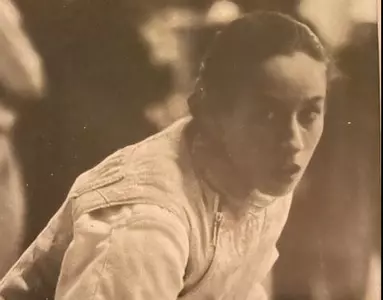
She followed that up placing sixth as a sophomore in 1993 to make All-American. In the 1995 tournament- also held at South Bend, she finished fourth as a senior, single-handedly placing UCSC in 24th place as a "team" in the NCAA's only co-ed championship.

1995 NCAA Fencing Championship in South Bend, Indiana (Courtesy NCAA)
"She's the most accomplished athlete ever at Santa Cruz, because fencing is not restricted to Division III; it's the entire membership field, including Penn State and Notre Dame," explained Burchard.